
10 Practical AI Hacks Every Busy Entrepreneur Should Know
- November 11, 2026
- Posted by: admin
- Categories: Entrepreneurship, Innovation
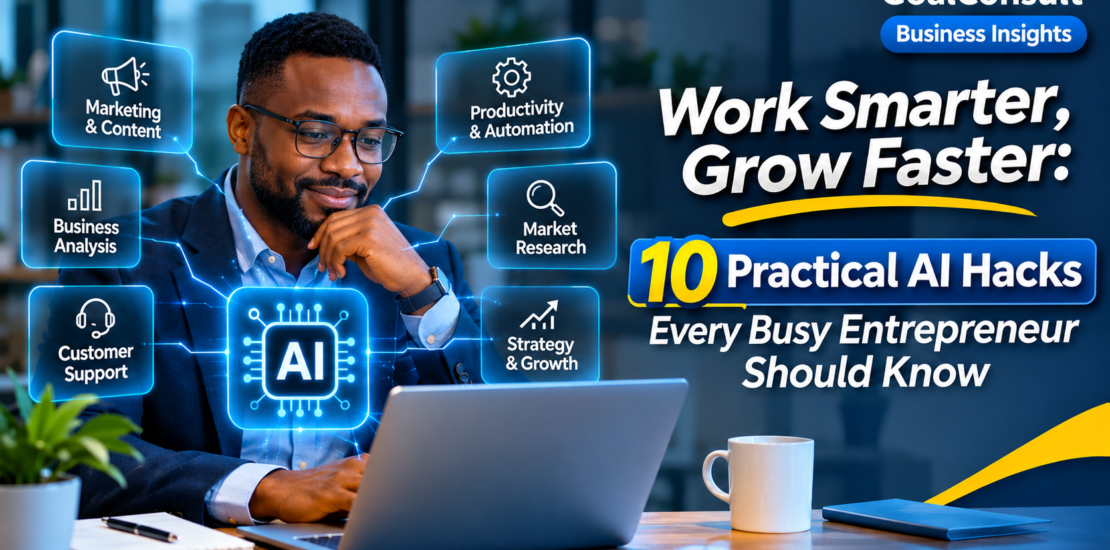
Work Smarter, Grow Faster: 10 Practical AI Hacks Every Busy Entrepreneur Should Know
By GoalConsult | Business Innovation & Digital Transformation
Running a business is not for the faint-hearted. Between managing customers, responding to emails, preparing reports, handling finances, marketing products, supervising employees and planning for growth, entrepreneurs often find themselves wearing too many hats.
For many small business owners, the challenge isn’t a lack of ideas or ambition. It is a lack of time.
But what if you could delegate some of those repetitive, time-consuming responsibilities without immediately hiring another employee? What if you had an assistant available around the clock to help you brainstorm ideas, analyse information, prepare business documents and improve your marketing?
Welcome to the world of Artificial Intelligence (AI).
AI is no longer a technology reserved for large corporations with enormous IT budgets. Today, entrepreneurs, freelancers, start-ups and small business owners can access powerful AI tools that help them work more efficiently, make better-informed decisions and compete more effectively.
The real opportunity, however, is not simply using AI because it is fashionable. It is understanding how to use it strategically to solve everyday business problems.
Here are ten practical AI hacks that every busy entrepreneur should consider.
1. Turn AI into Your Personal Business Assistant
Imagine having someone available to help you organise your thoughts, structure your business plans, draft correspondence and prepare meeting agendas.
That is one of the simplest ways to start using AI.
Tools such as ChatGPT, Claude and Gemini can assist with everyday administrative responsibilities that consume valuable hours.
You can use AI to:
- Draft professional emails and business correspondence.
- Prepare meeting agendas and minutes.
- Develop business proposals.
- Create standard operating procedures (SOPs).
- Organise daily and weekly priorities.
- Summarise lengthy documents and reports.
Try this prompt:
“Act as my executive business assistant. I run a small business providing [ describe your business ..]. Help me organise my priorities for this week. Identify five important activities, suggest deadlines and distinguish between urgent tasks and activities that contribute to long-term business growth.”
Instead of spending an hour organising your thoughts, you can use AI to create a structured starting point in minutes.
The important distinction is that AI assists your thinking; you remain responsible for the decisions.
2. Create Marketing Content Without Hiring an Entire Marketing Team
Marketing is essential for business growth, but consistently producing quality content can be exhausting.
Entrepreneurs often struggle to maintain an active presence on social media because creating posts, captions, newsletters, promotional messages and blog articles takes time.
AI can significantly simplify this process.
You can use it to:
- Generate social media content ideas.
- Write engaging Facebook, Instagram and LinkedIn posts.
- Develop monthly content calendars.
- Create email marketing campaigns.
- Draft product descriptions.
- Generate blog article outlines.
- Repurpose one piece of content into multiple formats.
For example, one blog article can become five social media posts, three short video scripts, a newsletter and a series of promotional messages.
This means you do not always have to start from scratch.
Try this prompt:
“Act as a digital marketing strategist. My business sells [ product or service..] to [target audience..]. Develop a seven-day social media content plan. Include engaging captions, suggested visuals, relevant calls to action and a clear objective for each post.”
Remember, AI-generated content should still reflect your brand personality. Review, personalise and refine it before publishing.
3. Automate Repetitive Customer Communication
How much time do you spend answering the same customer questions?
Questions about prices, delivery, business hours, available services, payment methods and product features can consume a surprising amount of time.
AI can help you develop a more efficient customer communication system.
For instance, you can use AI to:
- Prepare frequently asked questions (FAQs).
- Draft standard customer responses.
- Develop chatbot conversation flows.
- Create customer onboarding messages.
- Write follow-up messages after purchases.
- Prepare responses to common complaints.
With appropriate chatbot and automation platforms, some customer enquiries can even be handled automatically.
However, automation should not eliminate the human touch. Sensitive complaints, complex enquiries and important customer relationships still require personal attention.
The objective is to automate routine interactions so that you have more time to focus on customers who need your expertise.
4. Let AI Help You Understand Your Business Numbers
One of the biggest mistakes entrepreneurs make is treating financial information as something to review only when preparing accounts or meeting an accountant.
Your financial information should be a management tool, not simply a compliance requirement.
AI-powered analytical tools can help entrepreneurs interpret financial information and identify patterns that might otherwise go unnoticed.
For example, you can use AI to:
- Analyse monthly sales performance.
- Identify unusual expenditure patterns.
- Compare actual spending against budgets.
- Summarise cash flow information.
- Identify products or services generating the most revenue.
- Explain financial ratios in simple language.
- Prepare management reports.
Imagine uploading a properly anonymised spreadsheet containing six months of business expenses and asking AI to identify the major expenditure categories, unusual movements and possible cost-saving opportunities.
You could gain useful insights without spending hours manually reviewing every transaction.
Try this prompt:
“Act as a management accountant. Analyse the following business financial information. Identify the three largest expense categories, highlight significant changes between periods, assess potential cash flow concerns and recommend five practical areas for management attention. Do not assume missing information.”
Remember that AI can make calculation and interpretation errors. Always verify important financial calculations and consult a qualified professional for significant accounting, tax or investment decisions. Never upload confidential customer or financial information into an AI platform unless its data protection arrangements have been properly assessed.
5. Conduct Market Research Before Spending Money
Launching a new product, entering a new market or investing in a business idea without sufficient research can be expensive.
Traditionally, entrepreneurs may spend days gathering information about competitors, customers, industry developments and market opportunities.
AI can help accelerate the initial research process.
You can use AI to:
- Identify potential customer segments.
- Develop customer personas.
- Analyse publicly available competitor information.
- Brainstorm product differentiation strategies.
- Generate market research questionnaires.
- Identify potential business risks.
- Explore emerging industry trends.
For example, if you intend to open a childcare centre, AI can help you develop a market research framework covering location, target customers, competitor services, pricing considerations and operational requirements.
However, remember that AI-generated market information is not automatically accurate or current. Verify important findings using reliable sources, actual customer interviews and local market research.
AI can help you ask better questions, but real-world evidence should guide your investment decisions.
6. Build Professional Presentations and Business Documents Faster
Whether you are pitching to investors, training employees, presenting to clients or developing an internal business strategy, professional documents matter.
AI can help you move from a blank page to a structured, professional document much faster.
Consider using:
- ChatGPT for outlines, reports and proposals.
- Canva AI for visual content and marketing materials.
- Gamma for presentation development.
- Microsoft Copilot for assistance within Microsoft 365.
- Grammarly for writing refinement.
You can develop a business proposal, employee handbook, training presentation, project plan or strategic report with the assistance of these tools.
The real productivity benefit comes from using AI to establish the structure and first draft, leaving you to focus on accuracy, strategic thinking and quality.
7. Use AI to Improve Your Decision-Making
Entrepreneurs make decisions every day, often with incomplete information.
Should you increase your prices? Should you hire another employee? Should you introduce a new product? Should you expand into another location?
AI can act as a thinking partner by helping you examine different options and their potential consequences.
Rather than asking AI to make the decision for you, ask it to challenge your assumptions.
Try this prompt:
“Act as a critical business strategy consultant. I am considering [ describe your business decision..]. Evaluate the potential advantages, disadvantages, financial implications, operational challenges and risks. Identify assumptions I may be overlooking and suggest three alternative approaches. Be objective and do not simply agree with my proposal.”
This approach is particularly useful because entrepreneurs sometimes become so attached to an idea that they overlook potential weaknesses.
A good AI assistant should not simply tell you what you want to hear. It should help you think more critically.
8. Create Training Materials and Improve Employee Productivity
As businesses grow, training new employees and maintaining consistent standards become increasingly important.
AI can help entrepreneurs develop practical learning resources without starting from scratch.
You can use it to:
- Create employee induction materials.
- Develop training manuals.
- Prepare workplace policies.
- Generate assessment questions.
- Create instructional guides.
- Develop customer service training scenarios.
- Convert complex procedures into simple step-by-step instructions.
For example, a small retail business can use AI to develop a customer service training guide covering greeting customers, handling complaints, processing returns and managing difficult situations.
This helps create more consistent processes across the business.
However, all policies and training materials should be checked to ensure they comply with applicable employment laws, industry requirements and organisational standards.
9. Save Time by Combining AI with Business Automation
Here is where AI becomes particularly powerful.
Using AI to draft an email is helpful. Combining AI with automation to manage an entire workflow can be even more valuable.
Consider a simple customer enquiry process.
A potential customer completes an online enquiry form. An automation platform captures the information, adds the details to a customer management system, sends an acknowledgement email and alerts the relevant employee.
AI can then assist with classifying the enquiry or drafting a personalised response for review.
Tools such as Zapier, Make and Microsoft Power Automate can connect different applications and automate repetitive processes.
Other examples include:
- Automatically organising incoming customer enquiries.
- Sending appointment reminders.
- Generating weekly business summaries.
- Tracking leads and follow-up activities.
- Preparing recurring management reports.
- Organising tasks when new projects are created.
Start with one repetitive business process. Document how it currently works, identify unnecessary steps and then explore whether AI and automation can improve it.
Do not automate a broken process. Improve the process first, then automate it.
10. Develop an AI-Powered Growth Strategy
Perhaps the most valuable application of AI is not saving a few minutes here and there. It is using the technology to rethink how your entire business operates.
Ask yourself:
- Which business activities consume the most time?
- Which processes depend heavily on manual work?
- Where are customers experiencing unnecessary delays?
- Which decisions could benefit from better data analysis?
- What services could we offer if we had more operational capacity?
- How could AI help us serve more customers without proportionately increasing costs?
These questions move AI adoption from individual productivity hacks to genuine business transformation.
A small business that strategically integrates AI into marketing, administration, customer service, financial analysis and operations may create opportunities to improve productivity and competitiveness.
But technology alone does not guarantee business growth. A clear strategy, strong leadership, sound financial management and customer understanding remain essential.
A Practical 7-Day AI Challenge for Entrepreneurs
You do not need to implement all ten ideas at once. The best approach is to start small, experiment and measure the results.
Here is a simple seven-day challenge to get started.
Day 1 – Administration: Use ChatGPT to organise your weekly business priorities and draft a professional email.
Day 2 – Marketing: Create seven social media posts for your business using AI.
Day 3 – Customer Service: Develop a list of frequently asked questions and professional responses.
Day 4 – Financial Management: Use AI to analyse an anonymised business expense spreadsheet.
Day 5 – Market Research: Research three competitors and identify opportunities to differentiate your business.
Day 6 – Business Operations: Identify one repetitive business process that could be simplified or automated.
Day 7 – Strategy: Ask AI to evaluate one important business growth opportunity and challenge your assumptions.
At the end of the week, assess what worked, how much time you saved and which activities are worth incorporating into your regular business operations.
The Important Side of AI: Use It Responsibly
While AI offers enormous opportunities, entrepreneurs must also recognise its limitations.
AI can generate inaccurate information, make incorrect calculations, produce biased outputs and sometimes present fabricated information confidently.
There are also important concerns relating to data privacy, cybersecurity, intellectual property and the responsible use of customer information.
Before introducing AI into your business, establish a few basic principles:
- Protect confidential information: Do not casually upload customer records, employee details, passwords or sensitive financial information.
- Verify important outputs: Check facts, figures, legal information and financial recommendations before acting on them.
- Maintain human oversight: Important business decisions should remain under appropriate human supervision.
- Choose tools carefully: Understand the privacy, security and data-handling arrangements of the platforms you use.
- Be transparent: Where appropriate, inform customers and employees when AI is being used in ways that materially affect their interactions or decisions.
Responsible AI adoption is not simply about avoiding problems. It is about building trust and creating sustainable business value.
Final Thoughts: The Future Belongs to Entrepreneurs Who Adapt
Artificial Intelligence is changing how businesses operate, compete and grow.
For entrepreneurs, the opportunity is particularly exciting because many AI tools that were once available only to large organisations are now accessible to small businesses and individual professionals.
You do not need to be a programmer, data scientist or technology expert to benefit from AI.
You need to identify the problems slowing your business down, understand which tools can help solve them and develop the confidence to experiment.
Start with one task. Automate one repetitive process. Improve one business decision. Save one hour.
Then build from there.
The objective is not to replace your judgement, creativity or entrepreneurial instincts with artificial intelligence. It is to combine human intelligence with artificial intelligence to achieve more than either could accomplish alone.
Work smarter. Think strategically. Grow faster.
At GoalConsult, we believe that business success in the digital age will increasingly depend on the ability to embrace innovation, make informed decisions and turn technology into practical business value.
The question is no longer whether AI can help your business.
The question is: What are you waiting to put it to work on?
About GoalConsult
GoalConsult is committed to helping entrepreneurs, professionals and organisations develop the knowledge, strategies and capabilities needed to succeed in an evolving business environment. Through insights on business management, finance, innovation, entrepreneurship and digital transformation, we explore practical ways to turn ideas into results.