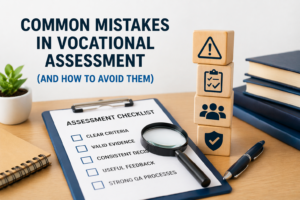
Common Mistakes in Vocational Assessment (And How to Avoid Them)
🟦 Introduction
Vocational assessment plays a critical role in ensuring that learners achieve the skills and competencies required for the workplace. However, many training providers face challenges in maintaining consistency, fairness, and compliance in their assessment practices.
Small mistakes in assessment can lead to bigger issues—affecting learner outcomes, quality assurance processes, and overall credibility.
🟦 Why Assessment Matters
Assessment is not just about grading learners—it is about confirming competence.
Effective assessment ensures that:
- Learners meet required standards
- Skills are applied in real-world contexts
- Outcomes are valid, reliable, and fair
When done correctly, assessment supports both learning and quality assurance.
🟦 Common Mistakes in Vocational Assessment
1. Inconsistent Assessment Decisions
Different assessors may interpret criteria differently, leading to unfair or inconsistent outcomes.
Solution:
Conduct regular standardization meetings to align assessment decisions.
2. Lack of Clear Assessment Criteria
When criteria are unclear, both assessors and learners struggle to understand expectations.
Solution:
Ensure assessment criteria are clearly defined and aligned with learning outcomes.
3. Poor Evidence Collection
Assessors sometimes accept insufficient or irrelevant evidence.
Solution:
Use clear evidence requirements and ensure all evidence meets validity and authenticity standards.
4. Limited Feedback to Learners
Generic or unclear feedback does not support improvement.
Solution:
Provide specific, constructive, and outcome-based feedback.
5. Weak Internal Quality Assurance (IQA)
Without proper IQA processes, errors in assessment go unchecked.
Solution:
Implement structured IQA systems with regular sampling and monitoring.
🟦 The Role of Internal Quality Assurance (IQA)
IQA ensures that:
- Assessment decisions are consistent
- Standards are maintained
- Assessors are supported
Strong IQA processes are essential for maintaining the integrity of vocational programs.
🟦 Best Practices for Improvement
To strengthen assessment practices:
- Train and support assessors regularly
- Standardize assessment decisions
- Maintain clear documentation
- Use structured IQA processes
- Continuously review and improve
🟦 Conclusion
Avoiding common mistakes in vocational assessment is essential for ensuring quality, consistency, and learner success. By implementing strong assessment and quality assurance practices, organizations can improve outcomes and maintain credibility.